

How to Sell Your Calgary Home Without Leaving Money on the Table
For several years, selling a home in Calgary was relatively straightforward. Strong demand, limited supply, and multiple offers meant that almost any home — priced almost anywhere — could sell quickly. That environment has changed.
The Q1 2026 data from CREB® tells an instructive story: in March alone, 3,409 new listings came to market and 1,881 homes sold. That means over 40% of March listings did not find a buyer. In higher-density segments like condos, months of supply reached 4.6, a level that clearly favours buyers who are willing to wait.
Selling well in this market is still very achievable. But it requires a more deliberate approach than it did in 2022 or 2023. Here's what that looks like in practice.
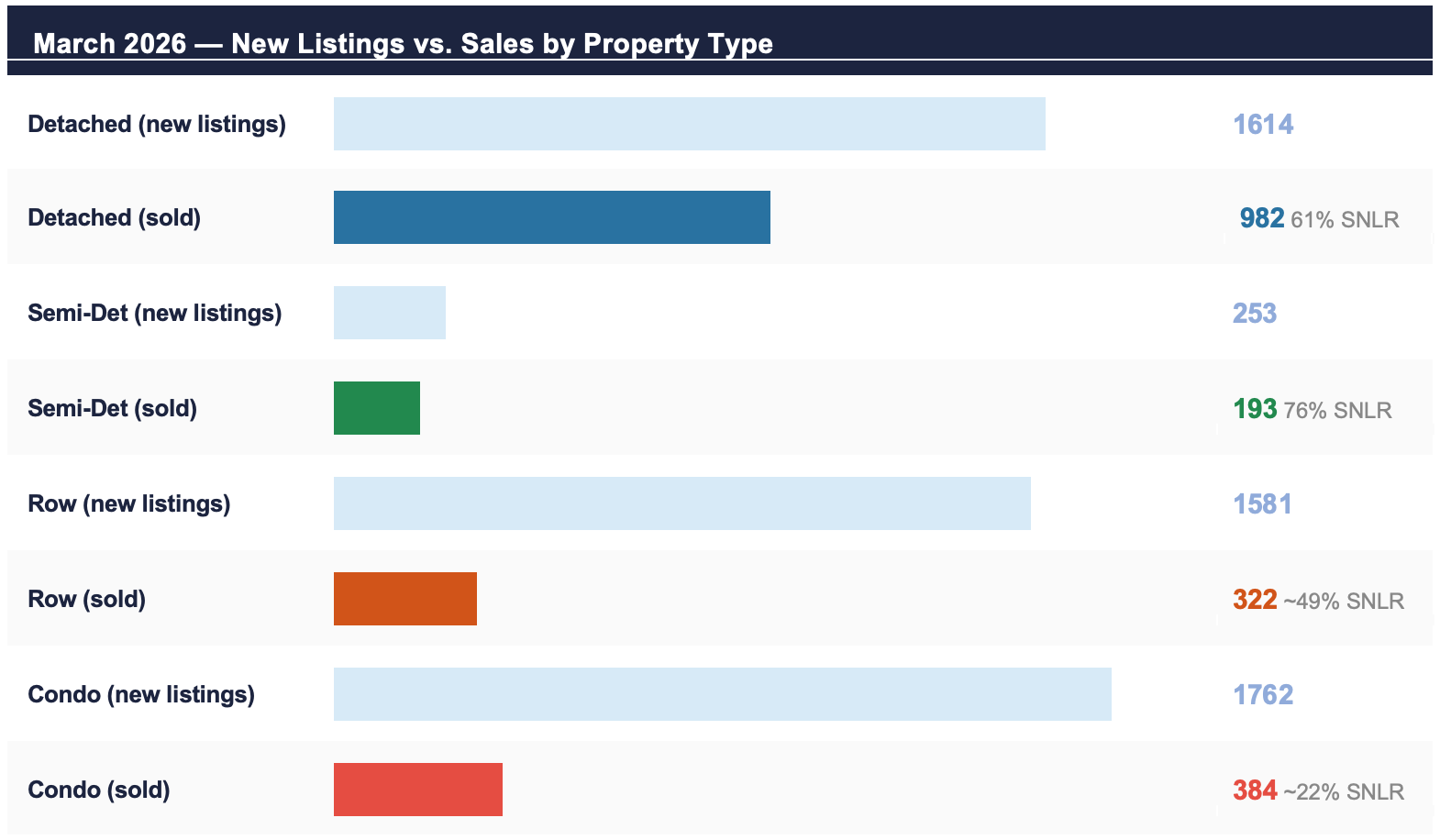
Sources: CREB® March 2026 Monthly Stats Package — City of Calgary
SNLR = Sales-to-New-Listings Ratio. A ratio above 60% generally indicates a seller's market; below 40% favours buyers. Row and condo listings are significantly outpacing sales in March 2026.
1. Price It Correctly From the Start
This is, without question, the most consequential decision in the selling process, and the one where sellers most often make a costly mistake.
In a high-demand market, an overpriced home will still attract offers because buyers don't have many alternatives. In a more balanced or softer market, an overpriced home simply doesn't attract showings. Buyers today have more choice, more time, and more data than they've had in years. They know when a home is priced above its fair market value, and they move on quickly.
The consequences of starting too high are real. Homes that sit on the market for three weeks or more in the current environment tend to accumulate a "why hasn't this sold?" stigma that's difficult to recover from. Price reductions attract attention, but not always the right kind. Buyers who track days-on-market data — and many do — interpret a price reduction as a signal that there may be room for further negotiation.
The right pricing approach starts with a clear-eyed look at what similar homes have actually sold for — not what they were listed at, and not what sellers hoped to receive — within a relevant time window and within a comparable radius. It also accounts for current competition: what else is available right now that a buyer could choose instead of your home?
“In March 2026, the citywide benchmark detached price was $741,300 (down 3.3% year-over-year). The difference between a home that sells in 10 days and one that sits for 60 is rarely the home itself — it's almost always the price.” Source: CREB® / WOWA.ca.
2. Prepare the Home With Intention — Not Exhaustion
There is a common belief that sellers need to renovate before listing. In most cases, that's not true. What buyers are really looking for is a home that feels well-maintained, clean, and move-in ready. A freshly painted main floor, professionally cleaned carpets, and a decluttered living space will do more for buyer perception — and buyer confidence — than a $30,000 kitchen update that may not reflect their tastes.
Before spending money on preparation, ask: Will this improvement help the home sell faster or for a higher price? Or am I doing it because it feels like the right thing to do? These are not the same question.
Preparation steps that consistently make a meaningful difference:
Decluttering and depersonalizing. Buyers need to imagine themselves living in the space. Too much furniture, personal photographs, and accumulated belongings make that difficult.
Addressing obvious deferred maintenance. Leaking faucets, cracked caulking, broken hardware, and stained ceilings create an impression of a home that hasn't been cared for — regardless of everything else.
Deep cleaning, including windows. A clean home shows better in person and in photographs, which is where the majority of buyers form their first impression.
Curb appeal. First impressions happen before a buyer walks through the door. A tidy front yard, a clean entrance, and a fresh front door go a long way.
3. Understand What Your Competition Looks Like
Your home does not sell in isolation. It sells in comparison. Buyers considering your property are almost certainly looking at three to five others in the same area and price range, comparing them against each other.
Before listing, it is worth understanding: What else is available right now that a buyer with your target buyer's profile might also be considering? How does your home compare on price per square foot, lot size, condition, and location? Where are you genuinely stronger, and where might a buyer prefer another option?
This competitive awareness shapes not only pricing but also how to position your home's story. If every home in your price range has a standard layout, your open-concept main floor is a genuine differentiator worth highlighting. If other listings are sitting with dated kitchens and yours has been updated, that's a meaningful advantage, but only if it's priced to reflect it.
4. Take Marketing Seriously
In a market with more homes available than buyers actively searching, presentation quality matters more than it did when every listing attracted immediate attention. Professional photography is no longer optional, it is the baseline expectation for any listing. More importantly, how a listing is written and positioned tells buyers whether this home deserves a closer look or can be skipped.
A well-crafted listing description is specific, honest, and focused on what makes the home genuinely worthwhile. It doesn't just list features; it tells a buyer what it feels like to live there, and why this home makes sense for their life.
Beyond the MLS® listing, targeted exposure — including social media reach, agent network activity, and well-timed open houses — can make a meaningful difference in attracting the right buyers rather than just more traffic.
5. Think Carefully Before Reacting to the First Offer
When an offer comes in below your asking price, the instinct is often to either reject it outright or accept the first counter. Neither response is always the right one.
The right response starts with understanding the whole offer, not just the price. Conditions, timelines, possession dates, and the buyer's financing situation all contribute to the value and risk profile of an offer. A clean, unconditional offer below asking may be worth more in practice than a higher price with financing conditions and an extended possession date.
What you are looking for is not necessarily the highest price. It's the offer that best serves your priorities, which may include certainty of closing, a possession date that fits your timeline, or minimizing the risk of a deal falling apart on conditions.
Thinking about selling your Calgary home this spring? Let's start with a conversation about your goals, timeline, and what the current market means for your specific property.
📞 (403) 383-3099 • verona@veronahomescalgary.ca • veronahomescalgary.ca
