

Relocating to Calgary? Here's What You Need to Know Before You Buy
Every year, Calgary welcomes a significant number of newcomers from other Canadian provinces, international destinations, and neighbouring communities who are making a move to the city for work, family, or quality of life. Relocating buyers face a challenge that local buyers don't: you're making one of the largest financial decisions of your life in a market you may have only visited once or twice.
The good news is that Calgary is genuinely one of Canada's more navigable real estate markets for newcomers. But there are a few things that catch out-of-province buyers off guard, things that experienced local buyers take for granted. This is a practical guide to the most important ones.

Alberta Has No Provincial Land Transfer Tax
If you're moving from Ontario, British Columbia, or most other provinces, you are probably used to land transfer tax being a significant closing cost. Ontario charges between 0.5% and 2.5% on the purchase price (plus an additional municipal tax in Toronto). BC has a similar structure.
Alberta does not have a provincial land transfer tax. There is a Land Titles registration fee, which is relatively modest, typically a few hundred to a few thousand dollars depending on the purchase price and mortgage amount. For a buyer purchasing a home at $700,000, this difference can represent $15,000–$20,000 in savings compared to what they would have paid in Ontario or BC. It is one of the most tangible financial advantages of buying in Alberta.
You Will Need a Real Property Report (RPR)
This is the item that most surprises buyers relocating from Ontario, where a Survey is common but less systematically required in every transaction.
In Alberta, the seller is typically responsible for providing a Real Property Report with evidence of municipal compliance before the transaction closes, unless the buyer explicitly agrees to waive this requirement. An RPR is a legal document prepared by an Alberta Land Surveyor that shows the location of improvements (buildings, fences, decks, garages) on a property relative to property lines and municipal setbacks.
Why does this matter? Without an RPR showing compliance, a buyer could unknowingly be taking on a property with an encroachment, an unpermitted structure, or a garage that sits too close to the property line. RECA (the Real Estate Council of Alberta) is clear that buyers should understand this requirement and confirm it is addressed before possession.
If you are purchasing a new build, an RPR is typically provided by the builder at a later stage. For resale homes, verify that an up-to-date RPR is included in the transaction.
The Market Is Segmented by Property Type — Know Which One You're Buying
This matters for relocating buyers because you're often comparing Calgary as a city against Vancouver or Toronto pricing. The comparison is broadly favourable. But Calgary's housing market in 2026 is not one market — it's several — and knowing which segment you're entering changes your offer strategy, your timeline, and your expectations.
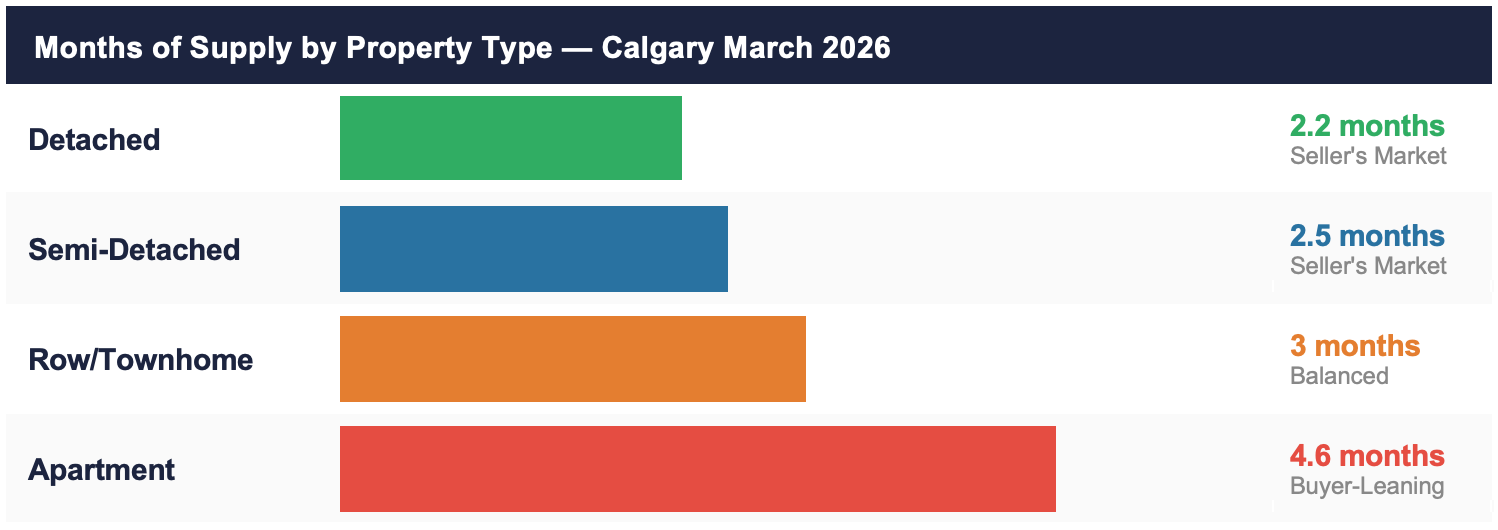
Sources: CREB® March 2026 Monthly Stats — City of Calgary
If you're buying a detached home, you're entering a seller's market with limited supply and upward price momentum in most districts. If you're buying a condo, you have considerably more negotiating room than the headline "Calgary is affordable" framing suggests. For a relocating buyer who is comparing on price alone, this segmentation matters enormously. A detached home at $741,300 (the March 2026 benchmark) behaves very differently in terms of offer strategy and negotiation than a condo at $300,300.
Knowing which property type you are targeting — and what market conditions look like in that specific segment — will shape how you prepare your offer, how much time you have to decide, and how realistically you can negotiate.
Working With a Local Agent Is Not Optional — It's Essential
Every real estate market has its own norms, processes, and paperwork. Alberta has its own standard offer documents, a specific disclosure framework under RECA, and local practices around conditions, possession dates, and what is included in a property sale.
For out-of-province buyers, working with a knowledgeable local agent is not just convenient, it's a meaningful layer of protection. An agent who knows the Calgary market well will help you:
Understand neighbourhood context and resale dynamics that don't show up in online listings.
Navigate Alberta-specific documents, including the purchase contract, property disclosure statement, and condominium documentation review.
Assess the RPR situation and any municipal compliance concerns before you commit.
Structure your offer in a way that is competitive without unnecessary risk.
Coordinate with your out-of-province mortgage broker or connect you with local lenders who understand the Alberta market.
You Can Do This Remotely — With the Right Support
One of the most common concerns I hear from relocating buyers is this: "How can I buy a home in a city I've only visited once?" It's a fair question, and the honest answer is that it is entirely possible to buy well from a distance, but it requires a more deliberate process than buying in a city where you already live.
In practice, the most successful relocating buyers I work with tend to do the following:
Schedule a focused trip to Calgary for 2–3 days of concentrated viewing, neighbourhood exploration, and community feel assessment. This is more productive than spreading visits across multiple shorter trips.
Prioritize community shortlisting before property shortlisting. Knowing which neighbourhoods fit your lifestyle, commute, and lifestyle preferences makes the property search far more efficient.
Get their mortgage pre-approval sorted before arriving, ideally with a lender familiar with Alberta properties. Conditions in Alberta differ slightly from other provinces, and lenders who know the market move faster.
Trust virtual tools — video tours, detailed photos, neighbourhood walkthroughs — but verify in person before making an offer when possible.
For buyers who truly cannot visit before making an offer, virtual showings supplemented by a detailed pre-offer agent walkthrough can work. This is not ideal, but it is workable with the right support and the right conditions in the offer.
Calgary's Affordability Advantage Is Real — But It Has Limits
Relative to Toronto or Vancouver, Calgary genuinely offers more housing for the money. The March 2026 detached benchmark of $741,300 represents significant value compared to equivalent properties in major Ontario or BC markets. Alberta's absence of a provincial land transfer tax adds to that advantage.
That said, affordability in Calgary is not without its constraints. Prices rose substantially between 2020 and 2024, and while the market has moderated, entry-level detached homes remain competitive. Buyers relocating with an Ontario or BC budget will often find themselves able to buy more in Calgary, but not everything they see will be in their price range, particularly in the most desirable inner-city and established communities.
The most important thing is to come in with a clear-eyed understanding of what the current market looks like, what you can genuinely afford in the segments you're targeting, and how Calgary's neighbourhoods actually compare to each other. That is exactly the kind of grounding a good local consultation should provide before your search even begins.
Relocating to Calgary and not sure where to start? Let's have a conversation — I help out-of-province buyers find their footing and make confident decisions, whether you're coming from Ontario, BC, or anywhere else.
📞 (403) 383-3099 • verona@veronahomescalgary.ca • veronahomescalgary.ca
